Future-oriented capabilities | Part 4/4
:focal())
How do you assess future-ready capabilities?
Most organisations recognise the need to invest in their future readiness. They experience the impact of digital transformation, increasing complexity and the accelerating pace of change. Yet when the question arises of where to begin, uncertainty often follows.
Should we invest in technology?
Should we strengthen our leadership?
Should we focus on becoming more data driven?
Should we redesign our organisational structure?
The answer is rarely straightforward. Every organisation faces different challenges. Not every capability has the same strategic importance, and not every investment delivers the same value.
That is why building a future-ready organisation does not start with solutions. It starts with insight.
The objective is not to excel equally across all eight capabilities. Rather, it is to understand which capabilities will make the greatest difference for your organisation. Future-ready organisations do not attempt to improve everything at once. Instead, they make deliberate choices about where to focus their development efforts.
The greatest opportunities for improvement are rarely found in the capabilities where organisations score the lowest. They are found in the capabilities that combine high strategic importance with low organisational maturity. These represent the greatest leverage for organisational development.
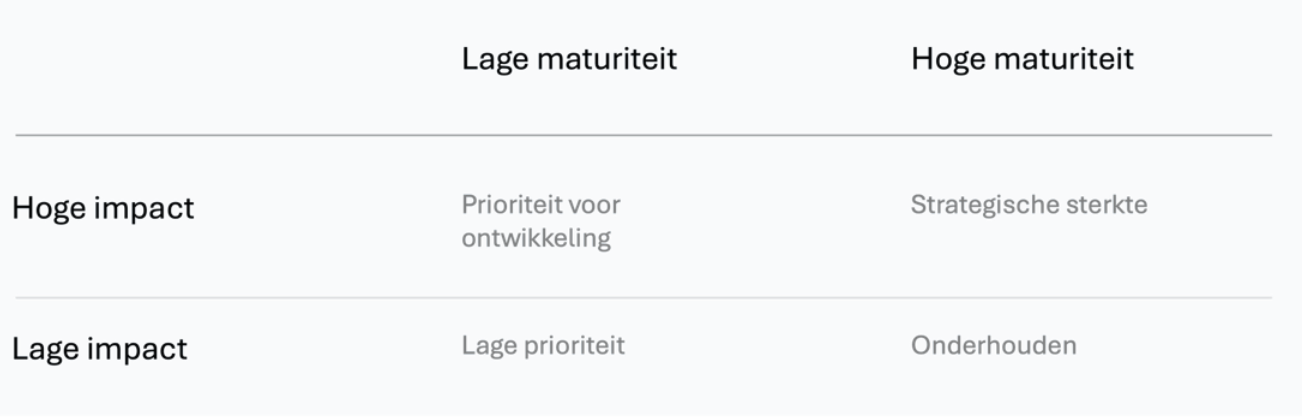 Figure: Capability Maturity Matrix
From intuition to informed decision-making
Many organisations assess their performance primarily on the basis of experience and perception. While these perspectives are valuable, they are often insufficient.
Leaders may recognise that collaboration is challenging without fully understanding where the biggest obstacles lie. Teams may feel that priorities change constantly but struggle to assess the impact on performance. Organisations may invest in digital solutions without having a clear understanding of their digital maturity. As a result, there is a risk of addressing symptoms rather than the underlying causes.
Future-ready organisations therefore begin with an objective understanding of their current situation. They identify their strengths, recognise where vulnerabilities exist and determine which capabilities will have the greatest impact on future success.
Two questions that make the difference
When assessing organisational capabilities, we have found that two dimensions are particularly important.
How important is this capability for our future?
Not every capability carries the same strategic significance. For some organisations, digital fluency may be a critical success factor. For others, the greatest challenge may lie in strengthening collaboration, leadership or change readiness.
The first step is therefore to understand which capabilities will have the greatest impact on delivering the organisation's strategy and preparing for future challenges.
The key question is not: "Which capabilities are important?"
It is: "Which capabilities are critical for our organisation?"
How mature are we today?
Equally important is understanding how well each capability is currently embedded within the organisation.
Do employees and leaders genuinely possess this capability?
Is it supported by the organisation's processes, structures and culture?
Is it consistently applied in day-to-day operations?
Only by understanding current maturity can organisations determine where development efforts are truly needed.
The greatest opportunities lie in the gap
The most valuable insights emerge when these two dimensions are considered together.
Capabilities with high strategic importance but low organisational maturity should receive the highest priority. They often represent both the greatest risks and the greatest opportunities for improvement.
Capabilities that combine high strategic importance with high maturity, on the other hand, represent strategic strengths that organisations can continue to build upon.
This approach enables organisations to take a far more focused view of organisational development. Rather than trying to improve everything simultaneously, they concentrate their investments where they will create the greatest impact.
From measurement to development
The purpose of a capability assessment is not to achieve a particular score. Its purpose is to enable better decisions.
The insights gained help organisations prioritise development initiatives, design targeted interventions and align investments with what is genuinely required.
These interventions may involve leadership development, strengthening data-driven decision-making, improving collaboration, redesigning governance or making more deliberate choices about organisational capacity.
The specific actions will differ from one organisation to another. The underlying approach, however, remains consistent:
First, understand what matters most.
Then, assess where the organisation stands today.
Only then determine the actions required to prepare for the future.
Future-readiness is never finished
Perhaps the most important insight is that future readiness is not a destination that organisations eventually reach.
The environment will continue to evolve. New technologies will emerge. Expectations will change. New challenges will arise. The question is therefore not whether organisations will ever become completely future proof.
The real question is whether they possess the insight and capabilities required to continue adapting.
Ultimately, the organisations that succeed are not those with the highest maturity scores. They are the organisations that recognise where they need to evolve and are able to translate those insights into meaningful action.
From insight to action
Future readiness is rarely achieved through a single transformation programme or a one-off initiative. In practice, organisations are shaped by the decisions they make every day: decisions about priorities, where organisational capacity is invested, which initiatives are discontinued and which new ambitions are pursued.
This is often where the greatest tension arises.
Many organisations invest in transformation programmes while continuing to operate according to established patterns. New strategic objectives are introduced without reducing existing commitments. Innovation is prioritised while operational workloads remain unchanged. Digital initiatives are launched, yet the organisation continues to make decisions in exactly the same way as before.
As a result, change is treated as an additional activity rather than becoming an integral part of the organisation's day-to-day operations.
Future-ready organisations make different choices. They recognise that organisational capacity is restricted and that every new ambition has consequences for the organisation's ability to deliver. They make priorities explicit and consistently align strategic choices with resources, responsibilities and expectations.
This creates not only greater focus but also greater credibility. Employees experience that the organisation's stated priorities are genuinely reflected in its decisions and actions.
Organisations seeking to prepare for the future therefore do not invest in a single solution. They invest simultaneously in strategic direction, leadership, collaboration, learning capability, data-driven decision-making and the deliberate allocation of organisational capacity.
Not because any one of these capabilities alone determines success, but because the interaction between them defines how adaptable an organisation truly is. It is precisely this interconnectedness that distinguishes organisations that simply undergo change from those that successfully transform.
The future is a capability
Many organisations still view the future as something that happens to them. They attempt to predict which technologies will emerge, which skills will become essential and which changes lie ahead.
History suggests a different perspective. Organisations rarely succeed because they accurately predict the future. They succeed because they develop the ability to adapt when the future unfolds.
The greatest challenge is therefore not identifying the next technological breakthrough. The real challenge is developing the organisational capabilities that enable sustained success, regardless of the changes that lie ahead.
Future-ready organisations do not invest solely in technology, processes or organisational structures. They invest in their ability to learn, collaborate, make informed decisions, provide direction and continuously adapt.
Organisations do not become future-ready by predicting the future. They become future-ready by developing the capability to adapt, time and again, as the future continues to evolve.
More Articles
:focal())
Beyond compliance: the human side of restructuring
:focal())
Use Case: How AI is changing HR
:focal())
Use Case: How AI predicts and improves visitor management
Our services
By bringing together strategy, people, and data, we create actionable solutions that strengthen culture, improve decision-making, and drive lasting change.
Careers at Select Advisory
Are you ready to embark on an exciting journey as trusted advisor? Don't hesitate to contact us directly, we're always looking for new talent to join our teams.