Future-oriented capabilities | Part 3/4
:focal())
The capabilities that make the difference
The three organisational conditions from the past article (clarity of direction, consistency in governance and connected execution) form the foundation of a future-ready organisation. However, on their own they are not enough. To translate these principles into everyday practice, organisations need specific capabilities that enable them to provide direction, make informed decisions, collaborate effectively and continuously adapt to change. These are what we refer to as organisational capabilities.
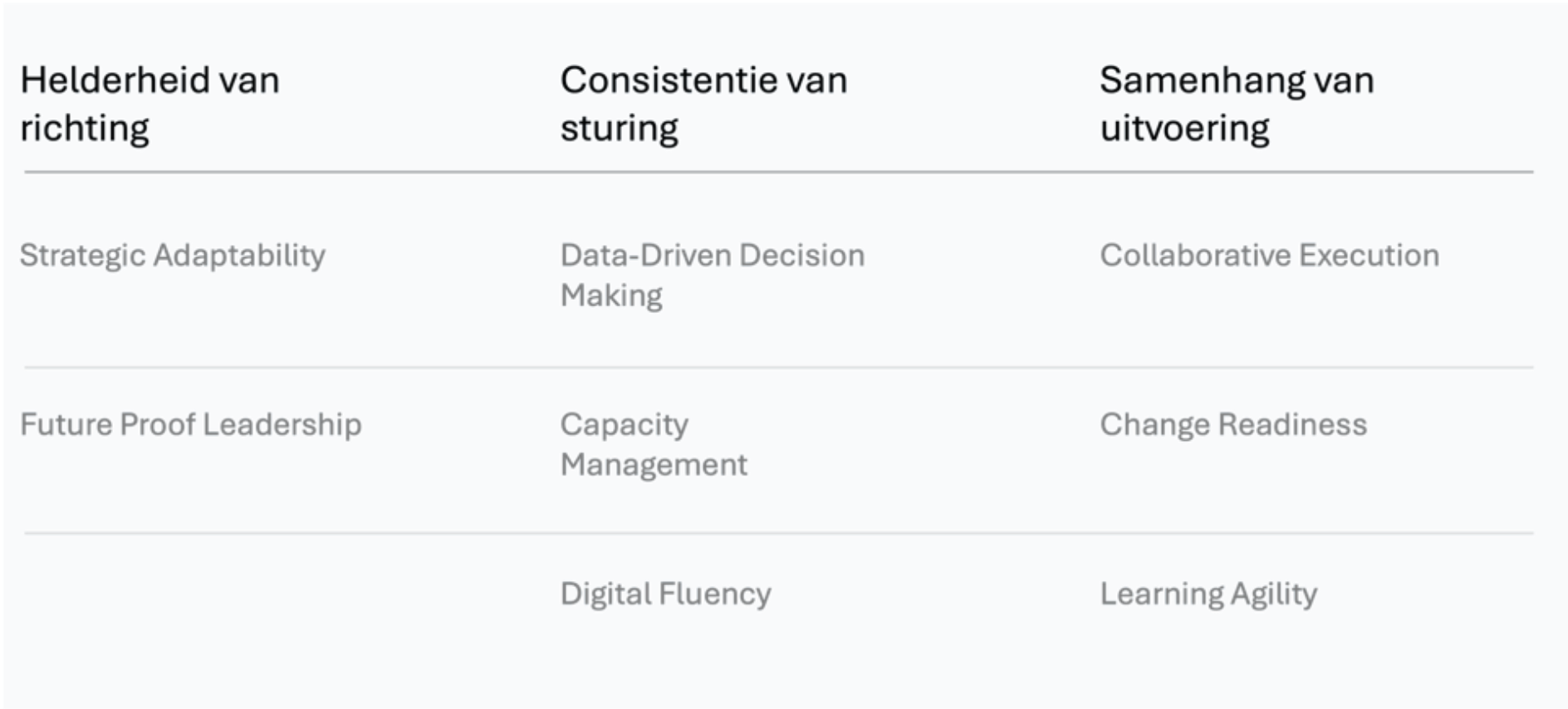
Some capabilities primarily contribute to strategic clarity, while others reinforce consistent governance or strengthen execution across the organisation. Together, they determine an organisation's ability to respond successfully to change and sustain long-term performance.
Today, many organisations focus their investments on technology, process optimisation and talent development. While these are all important, they are not sufficient to achieve sustainable success in an environment characterised by continuous change. The reason is simple: technology alone does not create competitive advantage. New systems can be purchased, processes can be replicated and expertise can be acquired relatively quickly. What is far more difficult to replicate is an organisation's ability to continuously adapt, learn and respond effectively to new circumstances. That ability is what we call organisational capability.
Capabilities go beyond individual skills or competencies. They are organisation-wide abilities that determine how effectively an organisation sets direction, makes decisions, collaborates, learns and implements change. They do not reside within a single team or function but emerge from the interaction between leadership, culture, governance, processes, data, organisational structures and behaviours.
In a world where change has become the norm rather than the exception, these capabilities increasingly determine whether organisations struggle to keep pace or use change as a catalyst for growth and innovation. Based on our experience, organisational assessments and conversations with leaders across industries, we have identified eight capabilities that are becoming increasingly critical for future-ready organisations.
Strategic Adaptability: the ability to maintain direction while the environment changes
Many organisations mistake stability for predictability. They develop detailed strategic plans, budgets and multi-year programmes, yet struggle to adjust them when circumstances change. This often creates a paradox: the greater the uncertainty, the more organisations cling to existing plans.
Future-ready organisations take a different approach. They maintain a clear strategic direction while continuously challenging their assumptions, priorities and initiatives. Rather than reacting to change after the fact, they actively incorporate new developments into their strategic decision-making. Adaptability therefore becomes more than a response to disruption; it becomes an integral part of the way the organisation operates.
Reflection question: How effectively can our organisation respond to changing circumstances without losing sight of strategic direction?
Data-Driven Decision-Making: the ability to turn insights into better decisions
In many organisations, data is still primarily used for reporting purposes. Dashboards are populated, performance indicators are monitored and increasing amounts of information are collected. Yet more data does not automatically lead to better decisions.
The real challenge lies not in collecting data but in translating insights into meaningful action. Organisations that excel in this capability gain a clearer understanding of risks, opportunities, organisational capacity and performance. As a result, they are able to make faster, more consistent and better-informed decisions in an increasingly complex environment.
Future-ready organisations view data not as a reporting tool but as a strategic asset. They combine objective insights with professional judgement to make better decisions about priorities, investments, risks and resource allocation. In doing so, data becomes an essential instrument for navigating uncertainty with greater confidence.
Reflection question: To what extent are strategic and operational decisions supported by relevant, reliable and actionable insights?
Digital Fluency: the ability to leverage technology strategically
Digital maturity is not about having access to the latest technology. It is about understanding what technology makes possible and how it can contribute to the organisation's strategic objectives.
The rise of artificial intelligence makes this capability more important than ever. Not because everyone needs to become a technology specialist, but because leaders and employees alike need to understand how technology can improve processes, support better decision-making and enhance service delivery.
Future-ready organisations invest in broad digital fluency across the organisation. They develop digital confidence not only within IT teams but also among leaders, business experts and operational staff. This enables better decisions, accelerates adoption and increases the value created through technology.
Reflection question: Do our leaders and employees understand how technology can strengthen the way our organisation operates?
Learning Agility: the ability to learn faster than the environment changes
Knowledge becomes outdated more quickly than ever before. Expertise that creates value today may no longer be sufficient tomorrow. As a result, the ability to continuously learn has become more valuable than existing knowledge alone.
Future-ready organisations create space for experimentation, reflection and knowledge sharing. They treat mistakes as opportunities to learn rather than failures to avoid and actively foster a culture in which learning is embedded in everyday work.
Organisations that learn faster than their environment changes develop a significant competitive advantage. They do not need to have every answer in advance. Instead, they establish mechanisms that enable them to acquire new insights quickly, test ideas effectively and translate learning into improved organisational performance.
Reflection question: How quickly does our organisation learn from experience and respond to new developments?
Collaborative Execution: the ability to work across organisational boundaries
Today's most significant challenges extend beyond departments, functions and areas of expertise. Yet many organisations continue to be constrained by organisational silos, fragmented responsibilities and limited cross-functional alignment.
Future-ready organisations consciously invest in collaboration. They establish clear roles, shared accountability and processes that facilitate cooperation across the organisation. This enables them to respond more quickly and address complex challenges more effectively.
Reflection question: How effectively do we collaborate across the organisation to achieve shared strategic objectives?
Change Readiness: the ability to successfully deliver change
Change is no longer an exception. It has become a permanent feature of organisational life. Yet many organisations continue to experience transformation initiatives that progress slowly or fail to deliver the intended impact.
In many cases, change initiatives do not fail because the strategic direction is incorrect, but because insufficient attention is given to the human and organisational aspects of change. Without engagement, clear communication and appropriate support, resistance grows and implementation slows.
Future-ready organisations actively strengthen their capacity for change. They involve employees from an early stage, build commitment throughout the organisation and establish mechanisms that enable change to be implemented more quickly and embedded more sustainably.
Reflection question: How effectively are we able to translate change initiatives into tangible and lasting results?
Future-Oriented Leadership: the ability to provide direction
Leadership is evolving from a focus on control towards creating meaning, building alignment and enabling collaboration. Today's leaders are expected to make decisions with incomplete information, balance competing interests and maintain trust while guiding their organisations through continuous change.
Future-ready organisations therefore invest not only in developing individual leaders but also in creating the organisational conditions that enable effective leadership to flourish.
Reflection question: Does our leadership help the organisation maintain focus, trust and direction in an increasingly complex environment?
Capacity Management: the ability to allocate organisational capacity deliberately
For almost every organisation, capacity has become one of the most significant constraints. The challenge is no longer a shortage of ideas, but a shortage of time, attention and execution capacity to realise them.
In many organisations, ambition grows faster than execution capability. New initiatives are introduced without retiring existing priorities, creating a structural imbalance between what the organisation wants to achieve and what it can realistically deliver.
Future-ready organisations recognise that organisational capacity is limited. They make deliberate choices about where scarce resources should be invested, which initiatives create the greatest value and which activities should be discontinued. The objective is not to reduce ambition, but to maximise impact by focusing effort where it matters most.
Reflection question: Do we have sufficient visibility of how our organisational capacity is being used, and are we directing it towards the initiatives that create the greatest value?
How the capabilities reinforce one another
These eight capabilities should not be viewed in isolation. They are mutually reinforcing and together determine an organisation's ability to adapt, execute and create sustainable value.
Organisations that invest in digital fluency without strengthening learning agility will struggle to embed new technologies successfully. Organisations that focus on leadership without improving collaboration will continue to encounter barriers during execution. Similarly, organisations that make ambitious strategic choices without understanding their available capacity risk creating aspirations that cannot be delivered.
Future readiness is therefore not achieved by developing individual capabilities in isolation. It is the result of strengthening an integrated system of organisational capabilities that collectively determine how effectively an organisation responds to change.
Figure: The interrelationship between organisational capabilities
Do you want to know how to assess future-ready capabilities and how to move from insight to action? Stay tuned for our latest article in this series!
More Articles
Future-oriented capabilities | Part 2/4
:focal())
The missing link between data and business value
:focal())
Future-oriented capabilities | Part 1/4
Our services
By bringing together strategy, people, and data, we create actionable solutions that strengthen culture, improve decision-making, and drive lasting change.
Careers at Select Advisory
Are you ready to embark on an exciting journey as trusted advisor? Don't hesitate to contact us directly, we're always looking for new talent to join our teams.